
Logo Oapen
  • Join
    • Deposit
    • For Librarians
    • For Publishers
    • For Researchers
    • Funders
    • Resources
    • OAPEN
        View Item 
        •   OAPEN Home
        • View Item
        •   OAPEN Home
        • View Item
        JavaScript is disabled for your browser. Some features of this site may not work without it.

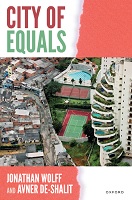
        City of Equals

        Thumbnail
        Download PDF Viewer
        Web Shop
        Author(s)
        Wolff, Jonathan
        de Shalit, Avner
        Language
        English
        Show full item record
        Abstract
        When we think about equality in the city, we are very likely to think first of the wide and growing divide between rich and poor, in material terms. Yet when we think more about a 'city of equals' it becomes apparent that how people feel treated by the city and those around them, and whether they can live according to their values, are much more central. Accordingly, combining their own reflections, a multi-disciplinary literature review, and, distinctively, more than 180 interviews in 10 cities in 6 countries, Wolff and de Shalit have derived an account of a city of equals based on the idea that it should give each of its city-zens a secure sense of place or belonging. Four underlying values structure this account. First, access to the goods and services of the city should not be based purely on the market. Second, each person should be able to live a life they find meaningful. Third, there should be diversity and wide social mixing. Fourth, there should be 'non-deferential inclusion': each person should be able to get access to what they are entitled to without being treated as less worthy than others. They should be able to enjoy their rights without bowing and scraping, waiting longer than others, or going through special bureaucratic hurdles. In sum, in a city of equals each person is proud of their city and has the (justified) feeling that their city is proud of (people like) them.
        URI
        https://library.oapen.org/handle/20.500.12657/87507
        Keywords
        cities, equality, inequality, relational equality, equality in the city, inclusion, diversity, social mixing, public reflective equilibrium, urban political philosophy
        DOI
        10.1093/oso/9780198894735.001.0001
        ISBN
        9780198894735
        Publisher
        Oxford University Press
        Publisher website
        https://global.oup.com/
        Publication date and place
        Oxford, 2023
        Classification
        Political science and theory
        Ethics and moral philosophy
        Geography
        Pages
        225
        Public remark
        Funder name: Blavatnik School of Government
        Rights
        https://creativecommons.org/licenses/by-nc-nd/4.0/
        • Imported or submitted locally

        Browse

        All of OAPENSubjectsPublishersLanguagesCollections

        My Account

        LoginRegister

        Export

        Repository metadata
        Logo Oapen
        • For Librarians
        • For Publishers
        • For Researchers
        • Funders
        • Resources
        • OAPEN

        Newsletter

        • Subscribe to our newsletter
        • view our news archive

        Follow us on

        License

        • If not noted otherwise all contents are available under Attribution 4.0 International (CC BY 4.0)

        Credits

        • logo EU
        • This project received funding from the European Union's Horizon 2020 research and innovation programme under grant agreement No 683680, 810640, 871069 and 964352.

        OAPEN is based in the Netherlands, with its registered office in the National Library in The Hague.

        Director: Niels Stern

        Address:
        OAPEN Foundation
        Prins Willem-Alexanderhof 5
        2595 BE The Hague
        Postal address:
        OAPEN Foundation
        P.O. Box 90407
        2509 LK The Hague

        Websites:
        OAPEN Home: www.oapen.org
        OAPEN Library: library.oapen.org
        DOAB: www.doabooks.org


        Export search results

        The export option will allow you to export the current search results of the entered query to a file. Differen formats are available for download. To export the items, click on the button corresponding with the preferred download format.

        A logged-in user can export up to 15000 items. If you're not logged in, you can export no more than 500 items.

        To select a subset of the search results, click "Selective Export" button and make a selection of the items you want to export. The amount of items that can be exported at once is similarly restricted as the full export.

        After making a selection, click one of the export format buttons. The amount of items that will be exported is indicated in the bubble next to export format.