
Logo Oapen
  • Join
    • Deposit
    • For Librarians
    • For Publishers
    • For Researchers
    • Funders
    • Resources
    • OAPEN
        View Item 
        •   OAPEN Home
        • View Item
        •   OAPEN Home
        • View Item
        JavaScript is disabled for your browser. Some features of this site may not work without it.

        A Republic of Men

        The American Founders, Gendered Language, and Patriarchal Politics
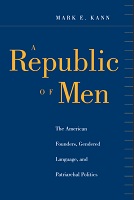
        Thumbnail
        Download PDF Viewer
        Download
        Author(s)
        Kann, Mark E.
        Language
        English
        Show full item record
        Abstract
        What role did manhood play in early American Politics? In A Republic of Men, Mark E. Kann argues that the American founders aspired to create a "republic of men" but feared that "disorderly men" threatened its birth, health, and longevity. Kann demonstrates how hegemonic norms of manhood–exemplified by "the Family Man," for instance--were deployed as a means of stigmatizing unworthy men, rewarding responsible men with citizenship, and empowering exceptional men with positions of leadership and authority, while excluding women from public life. Kann suggests that the founders committed themselves in theory to the democratic proposition that all men were created free and equal and could not be governed without their own consent, but that they in no way believed that "all men" could be trusted with equal liberty, equal citizenship, or equal authority. The founders developed a "grammar of manhood" to address some difficult questions about public order. Were America's disorderly men qualified for citizenship? Were they likely to recognize manly leaders, consent to their authority, and defer to their wisdom? A Republic of Men compellingly analyzes the ways in which the founders used a rhetoric of manhood to stabilize American politics.
        URI
        https://library.oapen.org/handle/20.500.12657/89347
        Keywords
        Political science and theory
        DOI
        10.18574/nyu/9780814763520.001.0001
        ISBN
        9780814763520, 9780814763520, 9780814763520, 9780814747131
        Publisher
        New York University Press
        Publication date and place
        New York, 1998
        Imprint
        NYU Press
        Classification
        Political science and theory
        Rights
        https://creativecommons.org/licenses/by-nc-sa/4.0/
        • Imported or submitted locally

        Browse

        All of OAPENSubjectsPublishersLanguagesCollections

        My Account

        LoginRegister

        Export

        Repository metadata
        Logo Oapen
        • For Librarians
        • For Publishers
        • For Researchers
        • Funders
        • Resources
        • OAPEN

        Newsletter

        • Subscribe to our newsletter
        • view our news archive

        Follow us on

        License

        • If not noted otherwise all contents are available under Attribution 4.0 International (CC BY 4.0)

        Credits

        • logo EU
        • This project received funding from the European Union's Horizon 2020 research and innovation programme under grant agreement No 683680, 810640, 871069 and 964352.

        OAPEN is based in the Netherlands, with its registered office in the National Library in The Hague.

        Director: Niels Stern

        Address:
        OAPEN Foundation
        Prins Willem-Alexanderhof 5
        2595 BE The Hague
        Postal address:
        OAPEN Foundation
        P.O. Box 90407
        2509 LK The Hague

        Websites:
        OAPEN Home: www.oapen.org
        OAPEN Library: library.oapen.org
        DOAB: www.doabooks.org


        Export search results

        The export option will allow you to export the current search results of the entered query to a file. Differen formats are available for download. To export the items, click on the button corresponding with the preferred download format.

        A logged-in user can export up to 15000 items. If you're not logged in, you can export no more than 500 items.

        To select a subset of the search results, click "Selective Export" button and make a selection of the items you want to export. The amount of items that can be exported at once is similarly restricted as the full export.

        After making a selection, click one of the export format buttons. The amount of items that will be exported is indicated in the bubble next to export format.