Logo Oapen
  • Join
    • Deposit
    • For Librarians
    • For Publishers
    • For Researchers
    • Funders
    • Resources
    • OAPEN
        View Item 
        •   OAPEN Home
        • View Item
        •   OAPEN Home
        • View Item
        JavaScript is disabled for your browser. Some features of this site may not work without it.

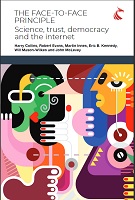
        The Face-to-Face Principle

        Science, Trust, Democracy and the Internet
        Thumbnail
        Download PDF Viewer
        Web Shop
        Author(s)
        Collins, Harry
        Evans, Robert
        Innes, Martin
        Kennedy, Eric B.
        Mason-Wilkes, Will
        McLevey, John
        Language
        English
        Show full item record
        Abstract
        The internet is changing the way that knowledge is made and shared. Knowledge-making in face-to-face settings is being replaced by information gathering from remote sources, whose origins may be concealed but which can create an illusion of intimacy. Though remote communication is beneficial in many ways – modern societies would fail without it -- and though the tight boundaries of the face-to-face can be used for evil purposes such as criminal conspiracy, if the overall trend to remote communication continues unchecked, it could be disastrous for the future of democracy and the very idea of truth itself. Too much reliance on remote communication threatens the core institutions of democratic societies. We explain the change in technical detail, from a systematic analysis of the workings of the face-to-face to a high level setting-out of its dangerous political implications. The analysis includes field studies, reflexive examination, drawing on the wide experience of the authors, of the stickiness of the face-to-face in our own work and other institutions, and network analysis which explains the illusion of intimacy that can be generated inadvertently or maliciously. We look at the apparent effectiveness of techniques such as blockchain and the limits of their domain. New information is provided about the malicious use of disinformation by foreign powers. We dramatise the dangers to Western pluralist democracy through a personal accounting of the 2020 American election. By drawing out the special features of face-to-face interaction and its constitutive role in creating societies, with science as the icon, the book sets out an agenda for civic education that can protect democratic institutions from the erosion of pluralism and the facile abandonment of trustworthy expertise. The authors conclude by returning to the themes set out at the start of the book, namely the crucial role played by trust in modern societies and the importance of face-to-face interactions in reproducing that trust, and the democratic institutions in which it should be invested.
        URI
        https://library.oapen.org/handle/20.500.12657/89839
        Keywords
        Democracy; Remote communication; Social media; Disinformation; Trust; Face-to-face communication
        DOI
        10.18573/book7
        ISBN
        9781911653332, 9781911653295, 9781911653301, 9781911653318
        Publisher
        Cardiff University Press
        Publisher website
        https://cardiffuniversitypress.org/
        Publication date and place
        2022
        Classification
        Crime and criminology
        Media studies: journalism
        Philosophy
        Political science and theory
        Psychology
        Sociology
        Pages
        283
        Rights
        https://creativecommons.org/licenses/by-nc-nd/4.0/
        • Imported or submitted locally

        Browse

        All of OAPENSubjectsPublishersLanguagesCollections

        My Account

        LoginRegister

        Export

        Repository metadata
        Logo Oapen
        • For Librarians
        • For Publishers
        • For Researchers
        • Funders
        • Resources
        • OAPEN

        Newsletter

        • Subscribe to our newsletter
        • view our news archive

        Follow us on

        License

        • If not noted otherwise all contents are available under Attribution 4.0 International (CC BY 4.0)

        Credits

        • logo EU
        • This project received funding from the European Union's Horizon 2020 research and innovation programme under grant agreement No 683680, 810640, 871069 and 964352.

        OAPEN is based in the Netherlands, with its registered office in the National Library in The Hague.

        Director: Niels Stern

        Address:
        OAPEN Foundation
        Prins Willem-Alexanderhof 5
        2595 BE The Hague
        Postal address:
        OAPEN Foundation
        P.O. Box 90407
        2509 LK The Hague

        Websites:
        OAPEN Home: www.oapen.org
        OAPEN Library: library.oapen.org
        DOAB: www.doabooks.org


        Export search results

        The export option will allow you to export the current search results of the entered query to a file. Differen formats are available for download. To export the items, click on the button corresponding with the preferred download format.

        A logged-in user can export up to 15000 items. If you're not logged in, you can export no more than 500 items.

        To select a subset of the search results, click "Selective Export" button and make a selection of the items you want to export. The amount of items that can be exported at once is similarly restricted as the full export.

        After making a selection, click one of the export format buttons. The amount of items that will be exported is indicated in the bubble next to export format.