Logo Oapen
  • Join
    • Deposit
    • For Librarians
    • For Publishers
    • For Researchers
    • Funders
    • Resources
    • OAPEN
        View Item 
        •   OAPEN Home
        • View Item
        •   OAPEN Home
        • View Item
        JavaScript is disabled for your browser. Some features of this site may not work without it.

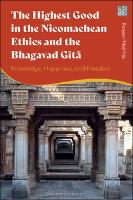
        The Highest Good in the Nicomachean Ethics and the Bhagavad Gita

        Knowledge, Happiness, and Freedom
        Thumbnail
        Download PDF Viewer
        Download
        Author(s)
        Majithia, Roopen
        Language
        English
        Show full item record
        Abstract
        This open access book presents a comparative study of two classics of world literature, offering the first sustained consideration of what unites and divides the Nicomachean Ethics and the Bhagavad Gita. Focusing on the nature of ethical action and how it relates to the highest good, Roopen Majithia demonstrates how the Gita stresses the objectivity of knowledge and freedom from being a subject, while the Ethics emphasizes the knower, working out Aristotle’s central commitment to the idea of substance as the primary building block of the world. Yet both the Gita and the Ethics explain variety in human behaviour in terms of three driving forces. Both agree moral agency is a construct that is a function of background, education, and habit, presupposing a cultural, political, and economic infrastructure, all of which shapes how each in turn conceives the highest good. What distinguishes the texts is how the content of right action is generated. Reading them together, alert to their individual accounts of how the practical relates to the reflective dimensions of life, Majithia enriches our understanding of two cornerstone texts in the Greek and Indian philosophical traditions. The ebook editions of this book are available open access under a CC BY-NC-ND 4.0 licence on bloomsburycollections.com. Open access was funded by The Marjorie Young Bell Faculty Fund, The Philosophy Department’s Baxter Fund and The Hart Almerrin Massey Endowment.
        URI
        https://library.oapen.org/handle/20.500.12657/90221
        Keywords
        Bhagavad Gita; Nicomachean Ethics; Aristotle; moral agency; cross-cultural philosophy
        DOI
        10.5040/9781350215122
        ISBN
        9781350215108, 9781350215115, 9781350215108
        Publisher
        Bloomsbury Academic
        Publisher website
        https://www.bloomsbury.com/academic/
        Publication date and place
        London, 2024
        Imprint
        Bloomsbury Academic
        Classification
        East Asian and Indian philosophy
        Hinduism
        Pages
        264
        Rights
        https://creativecommons.org/licenses/by-nc-nd/4.0/
        • Imported or submitted locally

        Browse

        All of OAPENSubjectsPublishersLanguagesCollections

        My Account

        LoginRegister

        Export

        Repository metadata
        Logo Oapen
        • For Librarians
        • For Publishers
        • For Researchers
        • Funders
        • Resources
        • OAPEN

        Newsletter

        • Subscribe to our newsletter
        • view our news archive

        Follow us on

        License

        • If not noted otherwise all contents are available under Attribution 4.0 International (CC BY 4.0)

        Credits

        • logo EU
        • This project received funding from the European Union's Horizon 2020 research and innovation programme under grant agreement No 683680, 810640, 871069 and 964352.

        OAPEN is based in the Netherlands, with its registered office in the National Library in The Hague.

        Director: Niels Stern

        Address:
        OAPEN Foundation
        Prins Willem-Alexanderhof 5
        2595 BE The Hague
        Postal address:
        OAPEN Foundation
        P.O. Box 90407
        2509 LK The Hague

        Websites:
        OAPEN Home: www.oapen.org
        OAPEN Library: library.oapen.org
        DOAB: www.doabooks.org


        Export search results

        The export option will allow you to export the current search results of the entered query to a file. Differen formats are available for download. To export the items, click on the button corresponding with the preferred download format.

        A logged-in user can export up to 15000 items. If you're not logged in, you can export no more than 500 items.

        To select a subset of the search results, click "Selective Export" button and make a selection of the items you want to export. The amount of items that can be exported at once is similarly restricted as the full export.

        After making a selection, click one of the export format buttons. The amount of items that will be exported is indicated in the bubble next to export format.