
Creating A Policed Society?
The Police and The Public in the Victorian West Riding, c.1840 – 1900
 Download
 Web Shop
Abstract
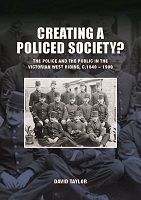
Creating a Policed Society? Provides an analysis of the evolution of policing and its impact on society in the West Riding of Yorkshire during the Victorian era. Unlike many previous police histories, which have focussed on specific (mainly urban) forces, it looks at developments across a region and brings out the complex and ongoing debates about policing, the diversity of police provision and the varied impact and responses that took place. As well as drawing on earlier works devoted to specific towns, the book offers a wide-ranging approach that utilises a range of hitherto underused sources that provide important insights into the details of police experience, both individual and collective. The book is structured around three major problem areas that have a relevance beyond the bounds of the West Riding. They are: (1) the extent to which the various police forces can be seen to be efficient; (2) the extent to which the Victorian West Riding can be seen as a policed society; and (3) the extent to which the policing in the county can be described as consensual. The author argues, firstly, that, despite ongoing problems retention, discipline and ill-health, most late-Victorian forces in the West Riding satisfied their local and national masters of their efficiency and were significantly less inefficient than their mid-century counterparts. Secondly, it is argued that notwithstanding the limitations to police powers, the Victorian West Riding was recognisably a policed society (or more accurately, a collection of policed societies), not least in the eyes of the majority of the local community. Finally, despite clear demonstrations of popular hostility to the police, in towns and country, in the third quarter of the nineteenth century and the persistence of anti-police sentiments, particularly in certain districts and among certain social groups, it is argued that, by a realistic and dynamic (rather than absolutist) definition of policing by consent, the Victorian West Riding was policed more by consensus than coercion.
David Taylor is emeritus professor of history at the University of Huddersfield and is the author of numerous books and articles on Victorian policing, including Policing the Victorian Town: The Development of the Police in Middlesbrough, c.1840-1914, Basingstoke, Palgrave Macmillan, 2002 and Beerhouses, Brothels and Bobbies: Policing by consent in Huddersfield and the Huddersfield District in the mid-nineteenth century, Huddersfield University Press, 2016.
Keywords
HistoryDOI
10.5920/policedSocietyISBN
9781862182332Publisher
University of Huddersfield PressPublisher website
https://unipress.hud.ac.uk/Publication date and place
Huddersfield, 2024Classification
Social and cultural history
Local history
Police law and police procedures