
Logo Oapen
  • Join
    • Deposit
    • For Librarians
    • For Publishers
    • For Researchers
    • Funders
    • Resources
    • OAPEN
        View Item 
        •   OAPEN Home
        • View Item
        •   OAPEN Home
        • View Item
        JavaScript is disabled for your browser. Some features of this site may not work without it.

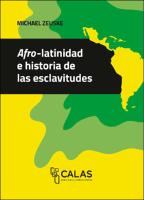
        Afro-latinidad e historia de las esclavitudes
        Thumbnail
        Download PDF Viewer
        Author(s)
        Zeuske, Michael
        Language
        Spanish
        Show full item record
        Abstract
        Hasta alrededor de 1900, el concepto de »afro« no existía en la historia de las esclavitudes. Las denominaciones de origen africano servían para menospreciar a los esclavos en la esclavitud atlántica. Se temía una »africanización« de la sociedad en las Américas. Ningún esclavo o ex esclavo se hubiera descrito a sí mismo como »afro«. Fernando Ortiz desarrolló el concepto en su libro Hampa-afrocubana como seguidor de Cesare Lombroso (1906). Estaba dirigido contra los negros. Desde 1960, los conceptos »afro« ganaron un significado muy positivo entre intelectuales. La masa de la población negra y de color en las Américas, especialmente en las áreas de habla hispana y portuguesa, seguirá usando la palabra y el término »negro«.
        URI
        https://library.oapen.org/handle/20.500.12657/95946
        Keywords
        Esclavitudes; Racism; Historia; Violence; Cultura; Postcolonialism; Populación Negra; South American History; Américas; Latin America; Bielefeld University Press; Diáspora; Rassismus; Gewalt; Postkolonialismus; Südamerikanische Geschichte; Lateinamerika
        DOI
        10.14361/9783839473009
        ISBN
        9783839473009, 9783839473009, 9783837673005
        Publisher
        Bielefeld University Press
        Publisher website
        https://www.bielefeld-university-press.org/
        Publication date and place
        2025
        Imprint
        Bielefeld University Press
        Series
        Afrontar las crisis desde América Latina, 21
        Classification
        History of the Americas
        Violence and abuse in society
        Social and cultural history
        Pages
        140
        Rights
        https://creativecommons.org/licenses/by-nd/4.0/
        • Imported or submitted locally

        Browse

        All of OAPENSubjectsPublishersLanguagesCollections

        My Account

        LoginRegister

        Export

        Repository metadata
        Logo Oapen
        • For Librarians
        • For Publishers
        • For Researchers
        • Funders
        • Resources
        • OAPEN

        Newsletter

        • Subscribe to our newsletter
        • view our news archive

        Follow us on

        License

        • If not noted otherwise all contents are available under Attribution 4.0 International (CC BY 4.0)

        Credits

        • logo EU
        • This project received funding from the European Union's Horizon 2020 research and innovation programme under grant agreement No 683680, 810640, 871069 and 964352.

        OAPEN is based in the Netherlands, with its registered office in the National Library in The Hague.

        Director: Niels Stern

        Address:
        OAPEN Foundation
        Prins Willem-Alexanderhof 5
        2595 BE The Hague
        Postal address:
        OAPEN Foundation
        P.O. Box 90407
        2509 LK The Hague

        Websites:
        OAPEN Home: www.oapen.org
        OAPEN Library: library.oapen.org
        DOAB: www.doabooks.org


        Export search results

        The export option will allow you to export the current search results of the entered query to a file. Differen formats are available for download. To export the items, click on the button corresponding with the preferred download format.

        A logged-in user can export up to 15000 items. If you're not logged in, you can export no more than 500 items.

        To select a subset of the search results, click "Selective Export" button and make a selection of the items you want to export. The amount of items that can be exported at once is similarly restricted as the full export.

        After making a selection, click one of the export format buttons. The amount of items that will be exported is indicated in the bubble next to export format.