
Logo Oapen
  • Join
    • Deposit
    • For Librarians
    • For Publishers
    • For Researchers
    • Funders
    • Resources
    • OAPEN
        View Item 
        •   OAPEN Home
        • View Item
        •   OAPEN Home
        • View Item
        JavaScript is disabled for your browser. Some features of this site may not work without it.

        Metamodeling for Extended Reality
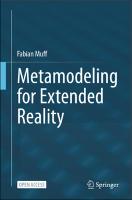
        Thumbnail
        Download PDF Viewer
        Web Shop
        Author(s)
        Muff, Fabian
        Language
        English
        Show full item record
        Abstract
        This open access book which is based on the author’s dissertation in 2024 explores the challenges of metamodeling in the context of extended reality and emphasizes the need for new concepts in metamodeling to effectively combine it with extended reality technologies. The central question of this work is how metamodeling can be used “in” and “for” extended reality. The book is structured in nine chapters: Chapter 1 introduces the topic by providing background information and outlining the research objectives, questions, methodology and structure. Chapter 2 delves into the existing literature and developments in the field. It covers various aspects of modeling, such as conceptual, enterprise, and metamodeling, as well as extended reality (XR), virtual reality (VR), augmented reality (AR), and the metaverse. Next, chapter 3 presents the generic requirements for metamodeling for augmented and virtual reality by systematically deriving use cases for joining AR and metamodeling. Chapter 4 then identifies specific requirements for integrating metamodeling with XR, such as coordinate mappings, visualization of model components, detection and tracking, context, or interaction. Subsequently, chapter 5 introduces a new domain-specific visual modeling language for creating augmented reality scenarios, particularly within the context of metamodeling, before chapter 6 outlines the conceptualization and design of a 3D enhanced metamodeling platform considering extended reality, detailing its structure, components, and the interconnection of its elements. Chapter 7 then presents the initial implementation of the various components of this modeling platform, and chapter 8 evaluates the newly introduced platform both theoretically and empirically. Eventually, chapter 9 concludes the book by an alignment with the initial research questions, discussing limitations, and provides a final summary and an outlook for further research. This book mainly aims at researchers in conceptual modeling, especially in projects related to XR, VR, or AR, as the presented new domain-specific modeling method for creating workflows for XR/VR/AR applications does not assume specific prior programming knowledge.
        URI
        https://library.oapen.org/handle/20.500.12657/99869
        Keywords
        conceptual modeling; metamodeling; extended reality; virtual reality; augmented reality; formal methods; software development; domain-specific modeling
        DOI
        10.1007/978-3-031-76762-3
        ISBN
        9783031767623, 9783031767623, 9783031767616
        Publisher
        Springer Nature
        Publisher website
        https://www.springernature.com/gp/products/books
        Publication date and place
        Cham, 2025
        Imprint
        Springer Nature Switzerland
        Classification
        Software Engineering
        Virtual reality
        Augmented reality (AR)
        Pages
        258
        Rights
        http://creativecommons.org/licenses/by/4.0/
        • Imported or submitted locally

        Browse

        All of OAPENSubjectsPublishersLanguagesCollections

        My Account

        LoginRegister

        Export

        Repository metadata
        Logo Oapen
        • For Librarians
        • For Publishers
        • For Researchers
        • Funders
        • Resources
        • OAPEN

        Newsletter

        • Subscribe to our newsletter
        • view our news archive

        Follow us on

        License

        • If not noted otherwise all contents are available under Attribution 4.0 International (CC BY 4.0)

        Credits

        • logo EU
        • This project received funding from the European Union's Horizon 2020 research and innovation programme under grant agreement No 683680, 810640, 871069 and 964352.

        OAPEN is based in the Netherlands, with its registered office in the National Library in The Hague.

        Director: Niels Stern

        Address:
        OAPEN Foundation
        Prins Willem-Alexanderhof 5
        2595 BE The Hague
        Postal address:
        OAPEN Foundation
        P.O. Box 90407
        2509 LK The Hague

        Websites:
        OAPEN Home: www.oapen.org
        OAPEN Library: library.oapen.org
        DOAB: www.doabooks.org


        Export search results

        The export option will allow you to export the current search results of the entered query to a file. Differen formats are available for download. To export the items, click on the button corresponding with the preferred download format.

        A logged-in user can export up to 15000 items. If you're not logged in, you can export no more than 500 items.

        To select a subset of the search results, click "Selective Export" button and make a selection of the items you want to export. The amount of items that can be exported at once is similarly restricted as the full export.

        After making a selection, click one of the export format buttons. The amount of items that will be exported is indicated in the bubble next to export format.