
Logo Oapen
  • Join
    • Deposit
    • For Librarians
    • For Publishers
    • For Researchers
    • Funders
    • Resources
    • OAPEN
        View Item 
        •   OAPEN Home
        • View Item
        •   OAPEN Home
        • View Item
        JavaScript is disabled for your browser. Some features of this site may not work without it.

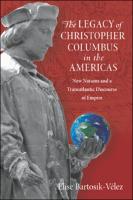
        The Legacy of Christopher Columbus in the Americas

        New Nations and a Transatlantic Discourse of Empire
        Thumbnail
        Download PDF Viewer
        Author(s)
        Bartosik-Velez, Elise
        Collection
        Knowledge Unlatched (KU); KU Select 2020: HSS Backlist Books
        Language
        English
        Show full item record
        Abstract
        Why is the capital of the United States named in part after Christopher Columbus, a Genoese explorer commissioned by Spain who never set foot on what would become the nation's mainland? Why did Spanish American nationalists in 1819 name a new independent republic "Colombia," after Columbus, the first representative of the empire from which they had recently broken free? These are only two of the introductory questions explored in <em>The Legacy of Christopher Columbus in the Americas</em>, a fundamental recasting of Columbus as an eminently powerful tool in imperial constructs.<br><br>Bartosik-Velez seeks to explain the meaning of Christopher Columbus throughout the so-called New World, first in the British American colonies and the United States, as well as in Spanish America, during the eighteenth and nineteenth centuries. She argues that during the pre- and post-revolutionary periods, New World societies commonly imagined themselves as legitimate and powerful independent political entities by comparing themselves to the classical empires of Greece and Rome. Columbus, who had been construed as a figure of empire for centuries, fit perfectly into that framework. By adopting him as a national symbol, New World nationalists appeal to Old World notions of empire.
        URI
        https://library.oapen.org/handle/20.500.12657/46331
        Keywords
        History; United States; History; Caribbean & West Indies; Literary Criticism; Caribbean & Latin American
        ISBN
        9780826519559
        Publisher
        Vanderbilt University Press
        Publisher website
        https://www.vanderbilt.edu/university-press/
        Publication date and place
        2016
        Imprint
        Vanderbilt University Press
        Classification
        History of the Americas
        Literature: history and criticism
        Rights
        https://creativecommons.org/licenses/by-nc-nd/4.0/legalcode
        • Harvested from KU

        Browse

        All of OAPENSubjectsPublishersLanguagesCollections

        My Account

        LoginRegister

        Export

        Repository metadata
        Logo Oapen
        • For Librarians
        • For Publishers
        • For Researchers
        • Funders
        • Resources
        • OAPEN

        Newsletter

        • Subscribe to our newsletter
        • view our news archive

        Follow us on

        License

        • If not noted otherwise all contents are available under Attribution 4.0 International (CC BY 4.0)

        Credits

        • logo EU
        • This project received funding from the European Union's Horizon 2020 research and innovation programme under grant agreement No 683680, 810640, 871069 and 964352.

        OAPEN is based in the Netherlands, with its registered office in the National Library in The Hague.

        Director: Niels Stern

        Address:
        OAPEN Foundation
        Prins Willem-Alexanderhof 5
        2595 BE The Hague
        Postal address:
        OAPEN Foundation
        P.O. Box 90407
        2509 LK The Hague

        Websites:
        OAPEN Home: www.oapen.org
        OAPEN Library: library.oapen.org
        DOAB: www.doabooks.org


        Export search results

        The export option will allow you to export the current search results of the entered query to a file. Differen formats are available for download. To export the items, click on the button corresponding with the preferred download format.

        A logged-in user can export up to 15000 items. If you're not logged in, you can export no more than 500 items.

        To select a subset of the search results, click "Selective Export" button and make a selection of the items you want to export. The amount of items that can be exported at once is similarly restricted as the full export.

        After making a selection, click one of the export format buttons. The amount of items that will be exported is indicated in the bubble next to export format.