
Logo Oapen
  • Join
    • Deposit
    • For Librarians
    • For Publishers
    • For Researchers
    • Funders
    • Resources
    • OAPEN
        View Item 
        •   OAPEN Home
        • View Item
        •   OAPEN Home
        • View Item
        JavaScript is disabled for your browser. Some features of this site may not work without it.

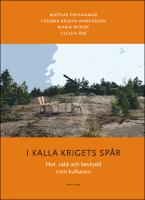
        I kalla krigets spår

        Kriterium

        Hot, våld och beskydd som kulturarv
        Thumbnail
        Download PDF Viewer
        Web Shop
        Author(s)
        Frihammar, Mattias
        Krohn Andersson, Fredrik
        Wendt, Maria
        Åse, Cecilia
        Language
        Swedish
        Show full item record
        Abstract
        Cultural heritage is not just something from the past, but always also reflects contemporary needs and desires. In the Traces of the Cold War describes the making of a diverse and innovative Swedish military heritage. The book shows how memories and material remains from a period characterized by fear and geopolitical tensions are infused with new meanings when bunkers, decommissioned military facilities and technology are transformed into luxury housing, attractive tourist destinations and museum exhibitions. Through field-visits to military heritage sites across Sweden, the authors examine what material objects, narratives and emotions that today represent the Cold War. These examinations show how military structures and equipment from a time associated with threat and danger become captivating elements of the cultural heritage, while also communicating specific ideas regarding security and protection. In the Traces of the Cold War takes a novel approach to cultural heritage by relating collective memory-making to security policy. Based on theoretical perspectives from critical heritage studies (CHS) and feminist international relations (IR), the analysis focuses on constructions of national belonging and underlines the role of gender and sexuality in narrations of security and protection. In a democracy, the subject of military violence must always be a matter of ethical and political conversations. Setting out from this assumption, the authors critically discuss how Cold War heritagisation produces militarization as “natural” and necessary. The book invites reflection on how history is written as well as on what the requirements are for a safe and secure society. In the Traces of the Cold War presents the results from an interdisciplinary research project. The authors are all researchers at Stockholm University and have written the book together.
        URI
        https://library.oapen.org/handle/20.500.12657/63210
        Keywords
        Bunkers; Bunkrar; Security politics; Säkerhetspolitik; Gender; Genus; Military threat; Militärt hot; Military Heritage; Militära kulturarv; Cold War; Kalla kriget
        DOI
        10.22188/kriterium.45
        ISBN
        9789170619298, 9789170614293
        Publisher
        Kriterium
        Publication date and place
        Lund, 2023
        Classification
        Social and cultural anthropology
        Museology and heritage studies
        History of architecture
        International relations
        Political science and theory
        Gender studies, gender groups
        Pages
        244
        Rights
        https://creativecommons.org/licenses/by-nc-nd/4.0/
        • Imported or submitted locally

        Browse

        All of OAPENSubjectsPublishersLanguagesCollections

        My Account

        LoginRegister

        Export

        Repository metadata
        Logo Oapen
        • For Librarians
        • For Publishers
        • For Researchers
        • Funders
        • Resources
        • OAPEN

        Newsletter

        • Subscribe to our newsletter
        • view our news archive

        Follow us on

        License

        • If not noted otherwise all contents are available under Attribution 4.0 International (CC BY 4.0)

        Credits

        • logo EU
        • This project received funding from the European Union's Horizon 2020 research and innovation programme under grant agreement No 683680, 810640, 871069 and 964352.

        OAPEN is based in the Netherlands, with its registered office in the National Library in The Hague.

        Director: Niels Stern

        Address:
        OAPEN Foundation
        Prins Willem-Alexanderhof 5
        2595 BE The Hague
        Postal address:
        OAPEN Foundation
        P.O. Box 90407
        2509 LK The Hague

        Websites:
        OAPEN Home: www.oapen.org
        OAPEN Library: library.oapen.org
        DOAB: www.doabooks.org


        Export search results

        The export option will allow you to export the current search results of the entered query to a file. Differen formats are available for download. To export the items, click on the button corresponding with the preferred download format.

        A logged-in user can export up to 15000 items. If you're not logged in, you can export no more than 500 items.

        To select a subset of the search results, click "Selective Export" button and make a selection of the items you want to export. The amount of items that can be exported at once is similarly restricted as the full export.

        After making a selection, click one of the export format buttons. The amount of items that will be exported is indicated in the bubble next to export format.