
Logo Oapen
  • Join
    • Deposit
    • For Librarians
    • For Publishers
    • For Researchers
    • Funders
    • Resources
    • OAPEN
        View Item 
        •   OAPEN Home
        • View Item
        •   OAPEN Home
        • View Item
        JavaScript is disabled for your browser. Some features of this site may not work without it.

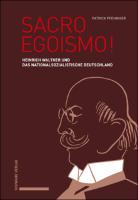
        Sacro Egoismo! - Heinrich Walther und das nationalsozialistische Deutschland
        Thumbnail
        Download PDF Viewer
        Web Shop
        Author(s)
        Pfenniger, Patrick
        Collection
        Swiss National Science Foundation (SNF)
        Language
        German
        Show full item record
        Abstract
        Was geschah hinter den Kulissen der vom «Dritten Reich» bedrohten Schweiz? Dieser Frage geht der Historiker Patrick Pfenniger nach. Er untersucht die Perspektive des damals einflussreichsten katholisch-konservativen Parlamentariers: des Luzerner National- und Regierungsrats Heinrich Walther (1862-1954). Obgleich Walther den Nationalsozialismus ablehnte, zeigte er sich nach dem Fall Frankreichs bereit, eine wirtschaftliche Kooperation mit Hitler-Deutschland voranzutreiben. Er wollte den Einfluss, den die Rechtskonservativen und insbesondere die Katholiken im Bundesstaat erlangt hatten, nicht wieder verlieren. Seine Haltung charakterisierte Walther als «Sacro Egoismo», als eine heilige Selbstsucht.
        URI
        https://library.oapen.org/handle/20.500.12657/91949
        Keywords
        Schweiz; Nationalsozialismus; Katholizismus; Heinrich Walther; Zweiter Weltkrieg
        DOI
        10.24894/978-3-7965-4692-1
        ISBN
        9783796546921, 9783796546921
        Publisher
        Schwabe Verlag
        Publisher website
        https://schwabe.ch/
        Publication date and place
        Basel, 2023
        Grantor
        • Schweizerischer Nationalfonds zur Förderung der Wissenschaftlichen Forschung - 10BP12_213428 - "Sacro Egoismo!" Heinrich Walther und das nationalsozialistische Deutschland (1933-1954) - Open Access Books
        Classification
        History and Archaeology
        Rights
        https://creativecommons.org/licenses/by-nc-nd/4.0/
        • Imported or submitted locally

        Browse

        All of OAPENSubjectsPublishersLanguagesCollections

        My Account

        LoginRegister

        Export

        Repository metadata
        Logo Oapen
        • For Librarians
        • For Publishers
        • For Researchers
        • Funders
        • Resources
        • OAPEN

        Newsletter

        • Subscribe to our newsletter
        • view our news archive

        Follow us on

        License

        • If not noted otherwise all contents are available under Attribution 4.0 International (CC BY 4.0)

        Credits

        • logo EU
        • This project received funding from the European Union's Horizon 2020 research and innovation programme under grant agreement No 683680, 810640, 871069 and 964352.

        OAPEN is based in the Netherlands, with its registered office in the National Library in The Hague.

        Director: Niels Stern

        Address:
        OAPEN Foundation
        Prins Willem-Alexanderhof 5
        2595 BE The Hague
        Postal address:
        OAPEN Foundation
        P.O. Box 90407
        2509 LK The Hague

        Websites:
        OAPEN Home: www.oapen.org
        OAPEN Library: library.oapen.org
        DOAB: www.doabooks.org


        Export search results

        The export option will allow you to export the current search results of the entered query to a file. Differen formats are available for download. To export the items, click on the button corresponding with the preferred download format.

        A logged-in user can export up to 15000 items. If you're not logged in, you can export no more than 500 items.

        To select a subset of the search results, click "Selective Export" button and make a selection of the items you want to export. The amount of items that can be exported at once is similarly restricted as the full export.

        After making a selection, click one of the export format buttons. The amount of items that will be exported is indicated in the bubble next to export format.