
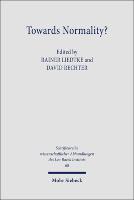
"Towards Normality?"
Acculturation of Modern German Jewry
 Download
Contributor(s)
Liedtke, R. (editor)
Collection
Knowledge Unlatched (KU)Language
EnglishAbstract
The present volume is the latest in a distinguished series, published under the auspices of the London Leo Baeck Institute, that addresses the issues of emancipation, assimilation and acculturation. It presents the work of an international group of scholars who approach these topics from a variety of innovative perspectives. The thread running through the diverse contributions, as indicated by the volume's title, is that of normality, clearly a close relation of emancipation and acculturation. Throughout the period from the Enlightenment to the 1930s, it can be argued that German-speaking Jews endeavoured to be like those around them, to become - in a (loaded) word - normal. While the term has not generally been employed by historians of European Jewry, the search for the normal can provide an interesting perspective from which to examine the diverse modes of German Jewish acculturation and integration, or lack thereof. Survey of contents: Peter Pulzer: Obituary for Werner E. Mosse - Rainer Liedtke / David Rechter: Introduction: German Jewry and the Search for Normality - Michael A. Meyer: German Jewry's Path to Normality and Assimilation: Complexities, Ironies, Paradoxes - Christhard Hoffmann: Constructing Jewish Modernity: Mendelssohn Jubilee Celebrations within German Jewry, 1829-1929 - Johannes Hei: "... durch Fluten und Scheiterhaufen": Persecution as a Topic in Jewish Historiography on the Way to Modernity - Christian Wiese: Struggling for Normality: The Apologetics of Wissenschaft des Judentums in Wilhelmine Germany as an Anti-colonial Intellectual Revolt against the Protestant Construction of Judaism - Deborah Hertz: The Troubling Dialectic Between Reform and Conversion in Biedermeier Berlin - Simone Lässig: The Emergence of a Middle-Class Religiosity: Social and Cultural Aspects of the German-Jewish Reform Movement During the First Half of the Nineteenth Century - Gregory A. Caplan: Germanising the Jewish Male: Military Masculinity as the Last Stage of Acculturation - Lisa Swartout: Segregation or Integration? Honour and Manliness in Jewish Duelling Fraternities - Ulrich Sieg: "Nothing more German than the German Jews"? On the Integration of a Minority in a Society at War - Elisabeth Albanis: A "West-östlicher Divan" from the Front: Moritz Goldstein Beyond the Kunstwart Debate - Keith H. Pickus: Divergent Paths of National Integration and Acculturation: Jewish and Catholic Educational Strategies in Nineteenth Century Hesse-Darmstadt - Robin Judd: Jewish Political Behaviour and the Schächtfrage, 1880-1914 - Silvia Cresti: German and Austrian Jews Concept of Culture, Nation and Volk - Helga Embacher: Jewish Identities and Acculturation in the Province of Salzburg in the Shadow of Antisemitism - Tobias Brinkmann: Exceptionalism and Normality: "German Jews" in the United States 1840-1880 - Mitchell B. Hart: Towards Abnormality: Assimilation and Degeneration in German-Jewish Social Thought
Keywords
Religion; History; World; Religion; JudaismPublisher
Mohr SiebeckPublisher website
https://www.mohrsiebeck.com/Publication date and place
2003Grantor
Imprint
Mohr Siebeck GmbH & Co. KGClassification
Religion & beliefs
General & world history
Judaism