
Logo Oapen
  • Join
    • Deposit
    • For Librarians
    • For Publishers
    • For Researchers
    • Funders
    • Resources
    • OAPEN
        View Item 
        •   OAPEN Home
        • View Item
        •   OAPEN Home
        • View Item
        JavaScript is disabled for your browser. Some features of this site may not work without it.

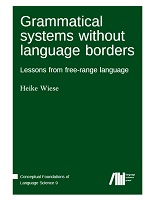
        Grammatical systems without language borders

        Lessons from free-range language
        Thumbnail
        Download PDF Viewer
        Author(s)
        Wiese, Heike
        Collection
        Knowledge Unlatched (KU); Language Science Press 2021 - 2023
        Language
        English
        Show full item record
        Abstract
        Current research in grammatical analysis and sociolinguistics points to two core characteristics of language that seem incommensurable at first sight: (1) research on linguistic structure indicates internal organisation and coherence, and the workings and interactions of distinct grammatical systems, but (2) sociolinguistic research suggests that language borders and bound ‘languages’ are counterfactual social constructs that cannot capture the diversity and fluidity of actual language use. This seems to constitute something like a “quantum-linguistic” paradox: language systems aren’t real (they are just ideological constructions), but at the same time, they are a reflection of actual structure. This book shows how this paradox can be resolved through an architecture that allows for grammatical systems without presupposing language borders: this architecture puts communicative situations, rather than languages, at the core of linguistic systematicity, while named languages are captured as optional sociolinguistic indices. The approach builds on insights from “free-range” language, a metaphor for language in settings that are less confined by monoglossic ideologies. The author looks at four different kinds of settings: urban markets, heritage language settings, multiethnic adolescent peer-groups, and digital social media.
        URI
        https://library.oapen.org/handle/20.500.12657/90228
        Keywords
        Language Arts & Disciplines; Linguistics
        DOI
        10.5281/zenodo.10276182
        ISBN
        9783961104291, 9783985540877
        Publisher
        Language Science Press
        Publisher website
        https://langsci-press.org/
        Publication date and place
        2024
        Grantor
        • Knowledge Unlatched
        Imprint
        Language Science Press
        Classification
        linguistics
        Rights
        https://creativecommons.org/licenses/by/4.0/
        • Harvested from KU

        Browse

        All of OAPENSubjectsPublishersLanguagesCollections

        My Account

        LoginRegister

        Export

        Repository metadata
        Logo Oapen
        • For Librarians
        • For Publishers
        • For Researchers
        • Funders
        • Resources
        • OAPEN

        Newsletter

        • Subscribe to our newsletter
        • view our news archive

        Follow us on

        License

        • If not noted otherwise all contents are available under Attribution 4.0 International (CC BY 4.0)

        Credits

        • logo EU
        • This project received funding from the European Union's Horizon 2020 research and innovation programme under grant agreement No 683680, 810640, 871069 and 964352.

        OAPEN is based in the Netherlands, with its registered office in the National Library in The Hague.

        Director: Niels Stern

        Address:
        OAPEN Foundation
        Prins Willem-Alexanderhof 5
        2595 BE The Hague
        Postal address:
        OAPEN Foundation
        P.O. Box 90407
        2509 LK The Hague

        Websites:
        OAPEN Home: www.oapen.org
        OAPEN Library: library.oapen.org
        DOAB: www.doabooks.org


        Export search results

        The export option will allow you to export the current search results of the entered query to a file. Differen formats are available for download. To export the items, click on the button corresponding with the preferred download format.

        A logged-in user can export up to 15000 items. If you're not logged in, you can export no more than 500 items.

        To select a subset of the search results, click "Selective Export" button and make a selection of the items you want to export. The amount of items that can be exported at once is similarly restricted as the full export.

        After making a selection, click one of the export format buttons. The amount of items that will be exported is indicated in the bubble next to export format.